Showing posts with label Java. Show all posts

Tuesday, October 4, 2011

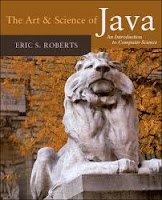
The Art and Science of Java: an Introduction to Computer Science


By Eric Roberts


Product Description

In The Art and Science of Java, Stanford professor and well-known leader in CS Education Eric Roberts emphasizes the student-friendly exposition that led to the success of The Art and Science of C. By following the recommendations of the Association of Computing Machinery’s Java Task Force, this first edition text adopts a modern objects-first approach that introduces students to useful hierarchies from the very beginning. Packages are translated into a minimally complex collection of pedagogical resources that make it easier to teach Java while retaining the language’s industrial strength.

http://astore.amazon.co.uk/javacoll0a-21/detail/0321486129

Tuesday, September 27, 2011

Stanford


You can find all the course (CS106A) handouts and materials/assignments that correspond to the on-line version of the course in one (big) package here:


Friday, September 23, 2011

Multitier architecture


In software engineering, multi-tier architecture (often referred to as n-tier architecture) is a client–server architecture in which the presentation, the application processing, and the data management are logically separate processes. For example, an application that uses middleware to service data requests between a user and a database employs multi-tier architecture. The most widespread use of multi-tier architecture is the three-tier architecture.
N-tier application architecture provides a model for developers to create a flexible and reusable application. By breaking up an application into tiers, developers only have to modify or add a specific layer, rather than have to rewrite the entire application over. There should be a presentation tier, a business or data access tier, and a data tier.
The concepts of layer and tier are often used interchangeably. However, one fairly common point of view is that there is indeed a difference, and that a layer is a logical structuring mechanism for the elements that make up the software solution, while a tier is a physical structuring mechanism for the system infrastructure.[1] [2] wiki

N-Tier Application Architecture

N-tier application architecture provides a model for developers to create a flexible and reusable application. By breaking up an application into tiers, developers only have to modify or add a specific layer, rather than have to rewrite the enitire application over, if they decide to change technologies or scale up. In the term "N-tier," "N" implies any number -- like 2-tier, or 4-tier; basically, any number of distinct tiers used in your architecture. Application architectures are part of Layer 7 of theOSI model. - webopedia